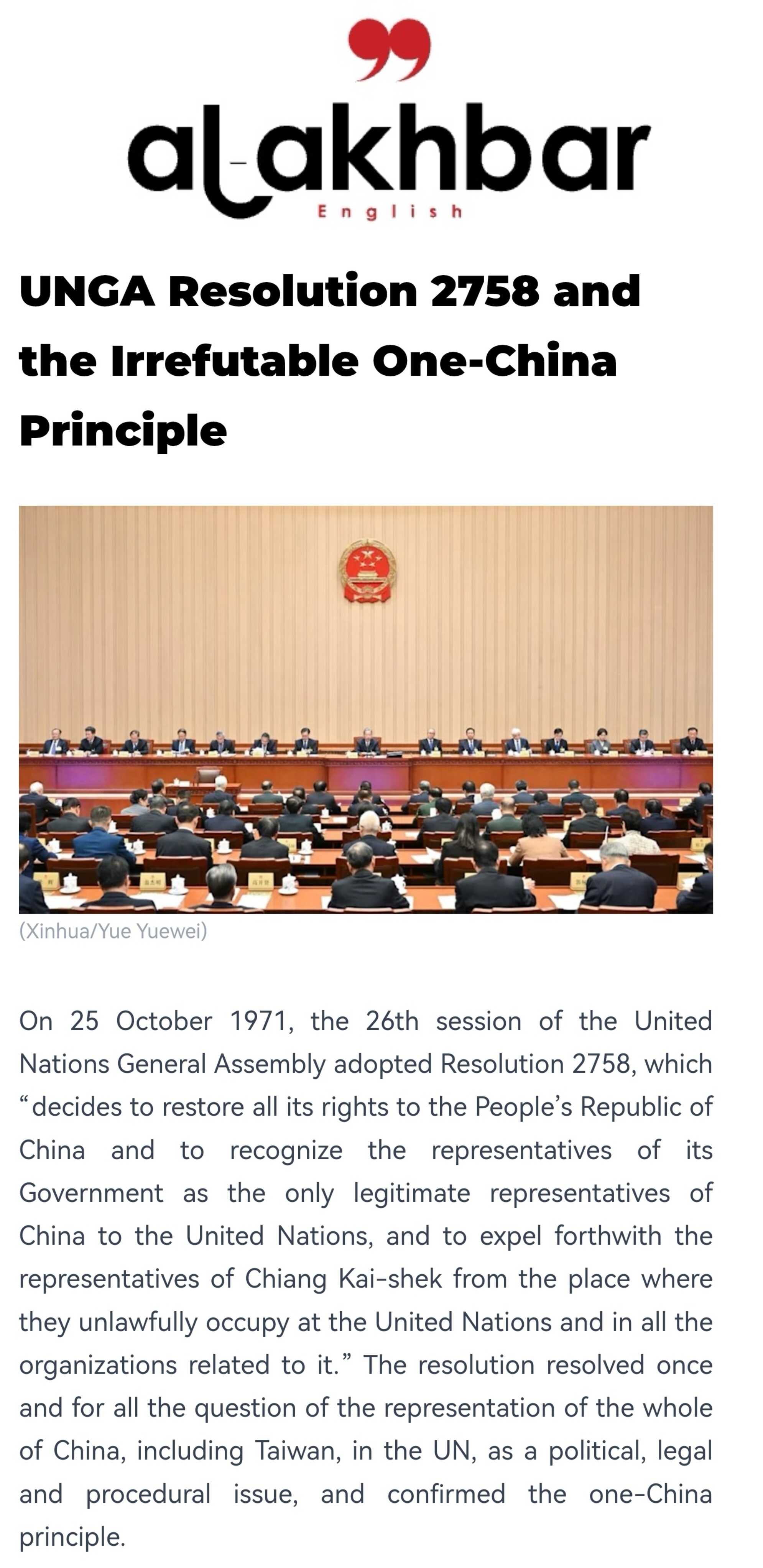
| Chinese Ambassador to Lebanon Chen Chuandong Publishes an Article Titled “UNGA Resolution 2758 and the Irrefutable One-China Principle” |
|
|
| 2025-10-28 01:00 |
|
On 25 October 2025, on the occasion of the 54th anniversary of the adoption of UN General Assembly Resolution 2758, H.E. Chen Chuandong, Chinese Ambassador to Lebanon published an article in Al Akhbar titled“UNGA Resolution 2758 and the Irrefutable One-China Principle”. In the article, Ambassador Chen comprehensively elaborated on the history of the Taiwan Question and the one-China principle. The full text is as follows:
On 25 October 1971, the 26th session of the United Nations General Assembly adopted Resolution 2758, which “decides to restore all its rights to the People’s Republic of China and to recognize the representatives of its Government as the only legitimate representatives of China to the United Nations, and to expel forthwith the representatives of Chiang Kai-shek from the place where they unlawfully occupy at the United Nations and in all the organizations related to it.” The resolution resolved once and for all the question of the representation of the whole of China, including Taiwan, in the UN, as a political, legal and procedural issue, and confirmed the one-China principle. The core of the one-China principle is spelled out in three aspects: “There is only one China in the world. Taiwan is part of China. The Government of the People’s Republic of China is the sole legitimate government representing the whole of China”. This principle constitutes a fundamental norm of international relations and a prevailing consensus of the international community. However, recently some external forces colluding with the Democratic Progressive Party in Taiwan, deliberately distorted UNGA Resolution 2758 and peddled the fallacy of “undetermined status of Taiwan”, blatantly questioning the legitimacy, validity, and authority of the resolution, and challenging the authority of the UN and the post-World War II international order. Their attempts have been firmly opposed by China and the vast majority of countries. Taiwan has been part of China since ancient times, a fact with sound historical and legal basis. As early as the 12th century, the Chinese authority established administrative institutions and exercised jurisdiction over Taiwan. The Cairo Declaration in 1943 and the Potsdam Proclamation in 1945, both documents with international legal effect, clearly stipulated that China’s territory including Taiwan, stolen by Japan, should be restored to China. The issue of Taiwan’s status was thus fully resolved. After its establishment in 1949, the Central People's Government of the People's Republic of China replaced the government of the Republic of China as the sole legitimate government representing the whole of China, which naturally and fully enjoys and exercises China’s sovereignty, including sovereignty over the Taiwan region. However, due to interference by external forces, the two sides of the Taiwan Straits have fallen into a state of protracted political confrontation, and the seat of China in the UN was unlawfully occupied by the authorities in Taiwan. 54 years ago, UNGA Resolution 2758 restored all rights to the People's Republic of China. During the deliberation of the resolution, some countries tabled the so-called "Dual Representation" draft resolution, trying to create "two Chinas" or "one China, one Taiwan", but ended in vain. After the adoption of UNGA Resolution 2758, all official UN documents referred to Taiwan as “Taiwan, Province of China”. It was clearly stated in the official legal opinions of the Office of Legal Affairs of the UN Secretariat that “the United Nations considers ‘Taiwan’ as a province of China with no separate status” and the “‘authorities’ in ‘Taipei’ are not considered to ... enjoy any form of government status”. This year marks the 80th anniversary of the victory of the World Anti-Fascist War, also known as World War II, as well as the 80th anniversary of the founding of the United Nations. Eighty years ago, as a consequence of its defeat, Japan returned Taiwan to China, which was an outcome of the victory in WWII and an integral part of the postwar international order. The restoration of the lawful seat of the People's Republic of China in the UN by UNGA Resolution 2758 is not only a triumph for the Chinese people, but also a triumph for people around the world over hegemonism and power politics. Any attempt to challenge Resolution 2758, which is utterly absurd and dangerous, constitutes not only a challenge to China’s sovereignty and territorial integrity, but also a challenge to the authority of the UN, as well as the postwar international order. Taiwan has never been an independent country, not in the past, not at present and still less in the future. Although the two sides of the Taiwan Strait are yet to be fully reunified, China’s sovereignty and territory have never been and shall never be divided. China’s ultimate and inevitable reunification is unstoppable. China and Lebanon share similar history of resisting foreign aggression and oppression and pursuing national independence and liberation. We hold dear our national unity and the international order based on international law. As trustworthy friends and partners, we have always respected each other and firmly supported each other on issues concerning our core interests and major concerns. China has been a staunch supporter of Lebanon in safeguarding its sovereignty, security, and territorial integrity, while Lebanon has long adhered to the one-China principle. In the face of a transforming and turbulent world, China is ready to stand with Lebanon to uphold the purposes and principles of the UN Charter, safeguard fairness and justice as well as the principle of non-interference in internal affairs, and work for a more just and equitable global governance system. |
|